arXiv
arXiv is a popular open-access e-print archive where researchers share preprints and scholarly papers in fields such as physics, mathematics, computer science, statistics, and quantitative biology.
What arXiv is
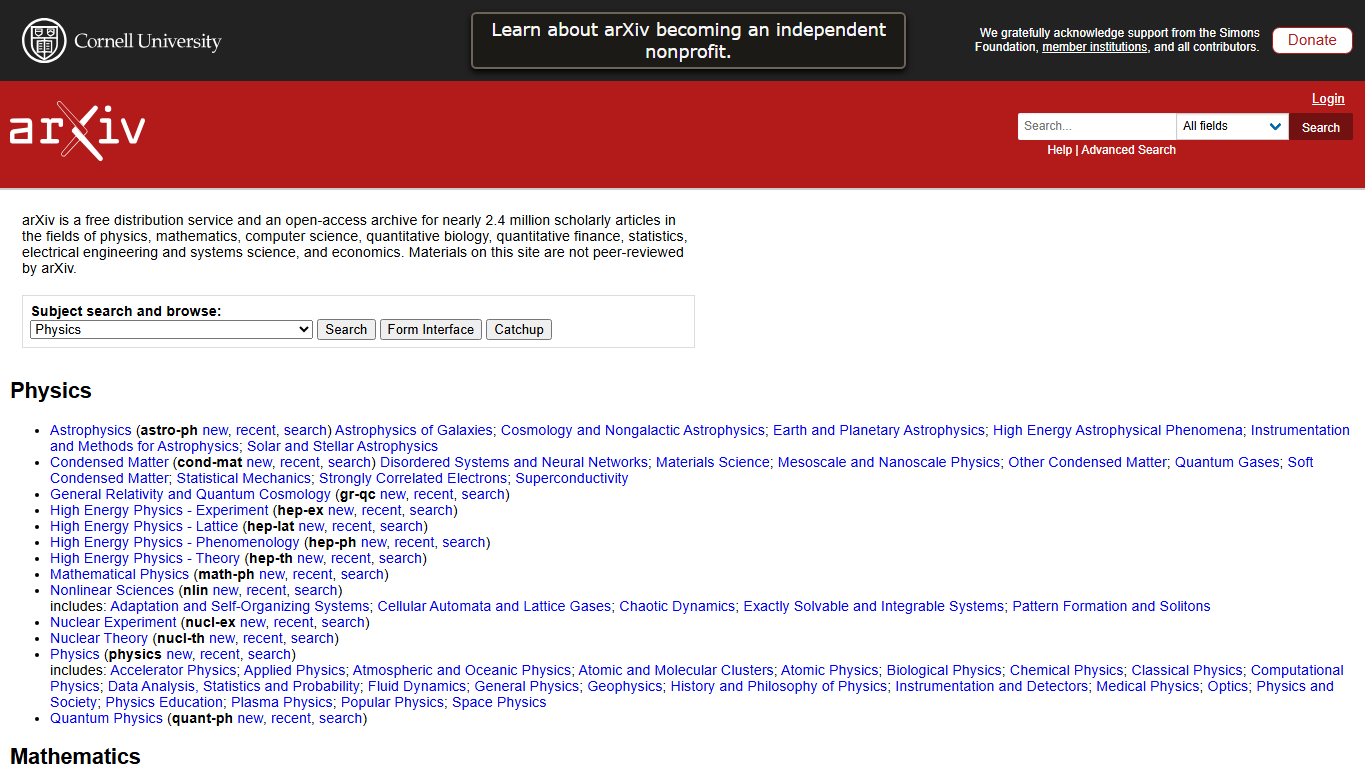
arXiv is an open-access e-print archive at arxiv.org where researchers share scholarly papers and preprints. It is best known for fast public access to research in fields such as physics, mathematics, computer science, statistics, electrical engineering, quantitative biology, economics, and related areas.
Preprints and e-prints
A preprint is a research manuscript shared before formal journal publication or peer-reviewed publication is complete. arXiv gives researchers a stable public place to distribute those manuscripts, cite them, and let other researchers read work earlier than traditional publishing timelines often allow.
Subject archives
arXiv organizes papers into subject areas and categories. That structure helps readers follow fields, search within a discipline, browse recent submissions, and discover work that may later appear in journals, conferences, books, or revised versions.
Submitting articles
The arXiv submission help pages explain how authors submit articles, including TeX or LaTeX source files and PDF workflows. Submission is not just uploading a file: authors need to prepare metadata, choose categories, follow policies, and understand how versions and replacements work.
Licenses and access
arXiv's license help pages explain choices authors make when submitting work. Open access does not mean every paper has identical reuse rights, so readers and downstream tools still need to check the license and citation information for a specific item.
API and machine access
arXiv also documents API access, which lets software query metadata and build research tools around arXiv records. That matters for search engines, recommendation systems, literature review tools, machine learning datasets, and other services that depend on scholarly metadata.
Who uses arXiv
arXiv is used by researchers, graduate students, professors, independent scholars, librarians, research engineers, data scientists, journalists, and readers who follow scientific work. It is especially important in fields where early access to papers, rapid discussion, and public version history are part of the research culture.
Strengths and cautions
arXiv's strength is fast, broad access to research papers. The cautions are important: an arXiv posting is not the same as peer review, papers can change across versions, licenses vary, and readers should evaluate methods, evidence, citations, and later publication status carefully.
Why it matters
arXiv matters because it changed how many research communities share work. It makes new findings visible sooner, supports open scholarly discovery, and gives researchers a durable way to circulate manuscripts outside the slower rhythms of conventional publishing.
WHOIS domain data
Data pulled: May 20, 2026View current WHOIS record
- Domain
- arxiv.org
- Registrar
- Network Solutions, LLC
- WHOIS server
- whois.networksolutions.com
- Referral URL
- http://www.networksolutions.com
- Created
- December 28, 1998
- Updated
- June 16, 2020
- Expires
- December 28, 2029
- Nameservers
- ns-cloud-d1.googledomains.com (216.239.32.109); ns-cloud-d2.googledomains.com (216.239.34.109); ns-cloud-d3.googledomains.com (216.239.36.109); ns-cloud-d4.googledomains.com (216.239.38.109)
- Domain status
- clientTransferProhibited
- Registrant contact location
- New York, NY, US
- Registrant contact phone
- +1.6072559849
- Registrant contact email
- cbf [at] tech [dot] cornell [dot] edu