HubSpot
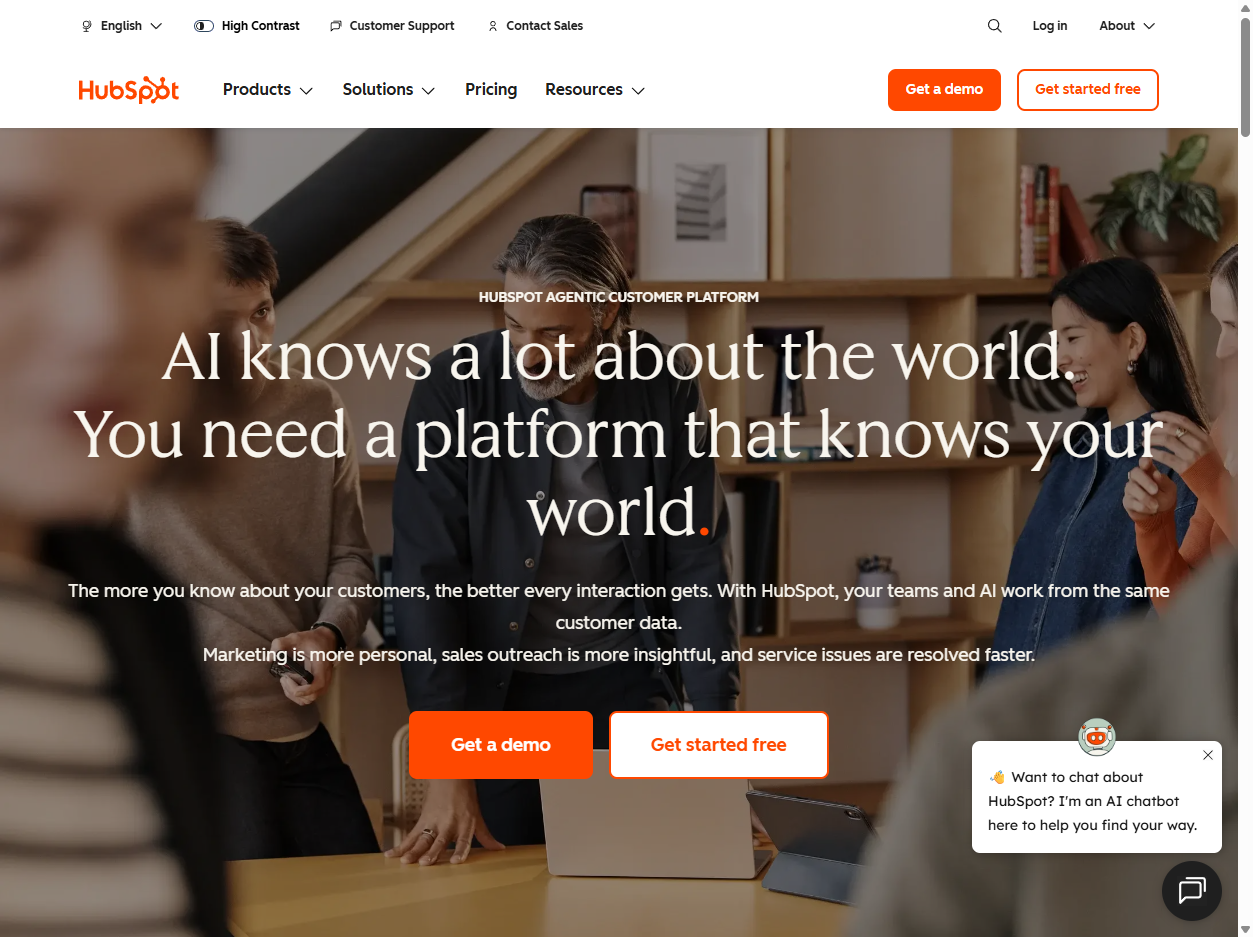
HubSpot is a customer platform and CRM website that combines marketing, sales, service, content, operations, commerce, automation, analytics, and AI tools for businesses.
What HubSpot is
HubSpot is a customer platform and CRM website for businesses. On HubSpot.com, teams can manage contacts, track deals, run marketing campaigns, publish content, automate workflows, support customers, analyze pipelines, and use AI tools across customer-facing work. The official HubSpot app is available on the App Store and Google Play.
.svg)

Inbound marketing roots
HubSpot began with the argument that customers were tuning out interruptive marketing and doing more research on their own. Its early focus was inbound marketing: publishing useful content, attracting visitors through search and social channels, converting them into leads, and nurturing relationships over time.
CRM and customer platform
The modern HubSpot product is organized around a CRM that connects customer records with marketing, sales, service, content, operations, and commerce tools. The aim is to keep customer data and customer actions in one place rather than scattered across disconnected apps.
Hubs and workflows
HubSpot packages many tools into product hubs. A company might use Marketing Hub for campaigns, Sales Hub for pipelines, Service Hub for support, Content Hub for websites and content, Operations Hub for data sync, and Commerce Hub for payments and quotes.
Growth and tradeoffs
HubSpot is popular with growing businesses because it can start simply and expand into a broad operating system for customer teams. The tradeoff is that pricing, data structure, permissions, integrations, and automation can become complex as the business grows.
AI in customer work
Like other business software platforms, HubSpot has added AI assistants and automation features for writing, summarizing, research, customer support, sales outreach, and data enrichment. The useful promise is faster execution, but teams still need careful governance around data quality, privacy, and brand voice.
Why it matters
HubSpot helped make inbound marketing and CRM software feel accessible to smaller and midsize businesses, not only enterprise sales teams. Its rise shows how the boundary between marketing software, sales software, support software, websites, analytics, and AI keeps getting thinner.
WHOIS domain data
Data pulled: May 24, 2026View current WHOIS record
- Domain
- hubspot.com
- IP address
- 104.17.91.187
- Registrar
- MarkMonitor Inc.
- WHOIS server
- whois.markmonitor.com
- Referral URL
- http://www.markmonitor.com
- Created
- February 6, 2005
- Updated
- January 5, 2025
- Expires
- February 6, 2027
- Nameservers
- jerry.ns.cloudflare.com (172.64.33.182); yolanda.ns.cloudflare.com (108.162.192.241)
- Domain status
- clientDeleteProhibited; clientTransferProhibited; clientUpdateProhibited
- DNSSEC
- signedDelegation
- Registrant contact
- Organization HubSpot, Inc.; address US.
- Registrant email
- Select Request Email Form at https://domains.markmonitor.com/whois/hubspot.com
- Technical contact email
- Select Request Email Form at https://domains.markmonitor.com/whois/hubspot.com