Bing
Bing is Microsoft's search engine, launched in 2009 as a replacement for Live Search. It has competed with Google through search features, partnerships, advertising, Windows and Edge integration, and more recently Copilot-powered AI search experiences.
What Bing is
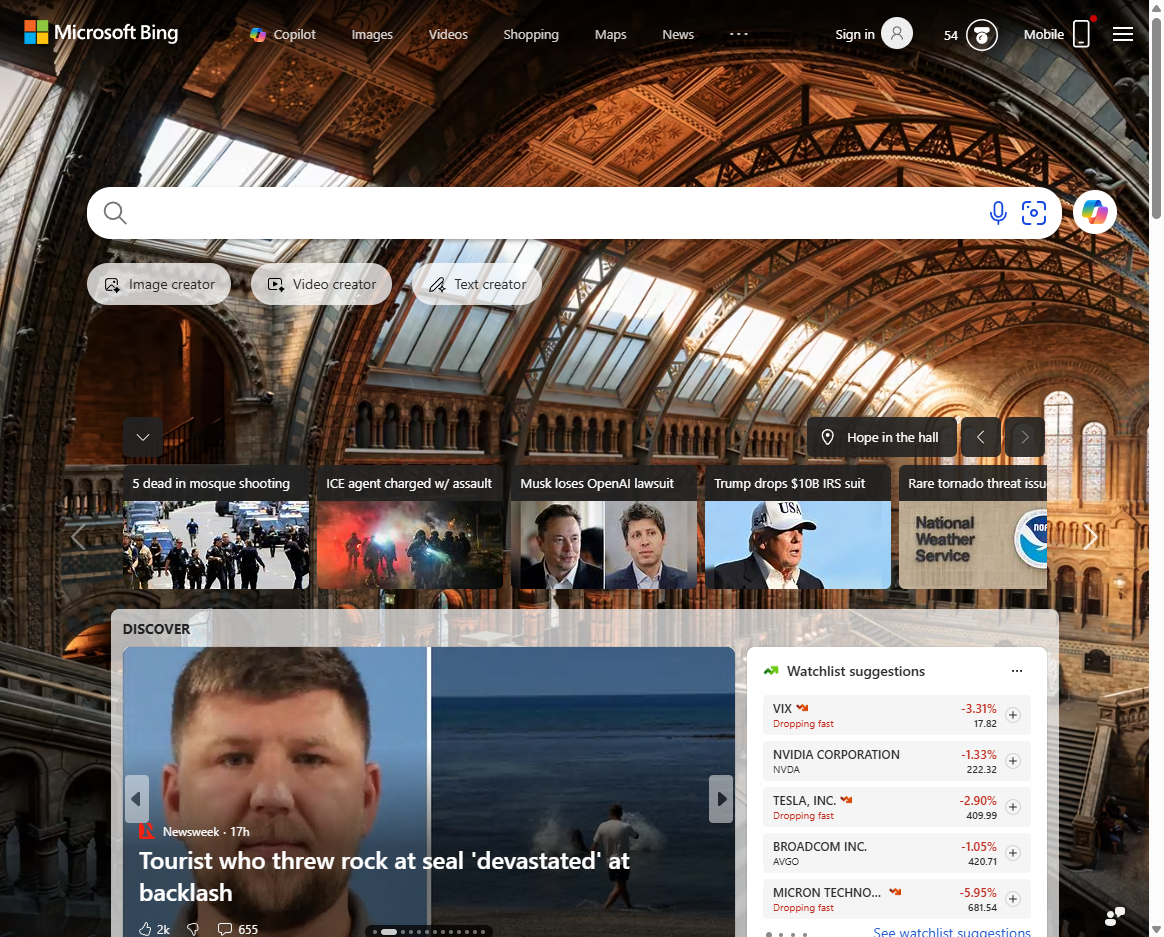
Bing is Microsoft's web search engine. On Bing.com, it provides web results, images, videos, news, maps, shopping information, local results, ads, and AI-assisted answers. It is also an infrastructure product: Bing powers or has powered search experiences across Microsoft products and partner sites such as Yahoo and AOL.
From Live Search to Bing
Before Bing, Microsoft operated search products under names such as MSN Search, Windows Live Search, and Live Search. Bing arrived in 2009 as a new brand and product reset. Microsoft described it as a decision engine, meaning it was meant to help users complete tasks rather than only return a list of links.
Decision engine idea
Bing's early design focused on common decisions: where to travel, what to buy, which local business to visit, or what answer best fits a query. Features such as richer result pages, visual search, travel tools, shopping filters, maps, and quick answers reflected Microsoft's attempt to organize search around user intent.
Search market role
Bing has long been the main large-scale alternative to Google in English-language web search. It has not overtaken Google in general search, but it has remained important because Microsoft can integrate it into Windows, Edge, Office, Xbox, advertising tools, and enterprise products. Its scale also matters to advertisers and publishers who want alternatives to Google traffic.
Partnerships and distribution
Bing's reach expanded through partnerships. Microsoft and Yahoo announced a search agreement in 2009, and Bing later powered Yahoo search results under that relationship. In 2015, Microsoft announced that Bing would power AOL search and search advertising beginning in 2016. These deals made Bing visible beyond Bing.com itself.
Rise and reinvention
Bing rose as Microsoft's serious re-entry into search after earlier brands struggled to define themselves. Its reinvention came from persistence rather than a single breakthrough: better ranking, partner distribution, advertising tools, Windows and Edge defaults, and later AI features. It became less a standalone challenger and more a search layer inside Microsoft's broader ecosystem.
Copilot and AI search
In 2023, Microsoft launched an AI-enhanced Bing experience using advanced models from Microsoft and OpenAI. The feature evolved into Copilot in Bing and related Copilot products. This shifted Bing's identity from a conventional search engine toward a hybrid of links, summaries, chat-style answers, image generation, and task assistance.
Why it matters
Bing matters because it keeps web search from being a one-company story. It powers partner search, supports Microsoft's advertising business, supplies data and grounding for AI features, and gives users and publishers a second major search ecosystem. Its history also shows how search competition can depend as much on defaults, partnerships, and platform integration as on the search page itself.