Quora
Quora is a question-and-answer platform where people ask questions, write answers, follow topics, read expert perspectives, and discover knowledge through feeds and communities. Founded in 2009 by Adam Dโ€Angelo and Charlie Cheever, Quora later expanded into AI with Poe.
What Quora is
Quora is a question-and-answer website where users ask questions, write answers, follow topics, upvote useful responses, read perspectives from people with different backgrounds, and build reusable pages around specific questions. On Quora.com, those pages sit between a knowledge forum, social network, search result, and long-form answer archive. The official Quora app is available on the App Store and Google Play.
.svg)

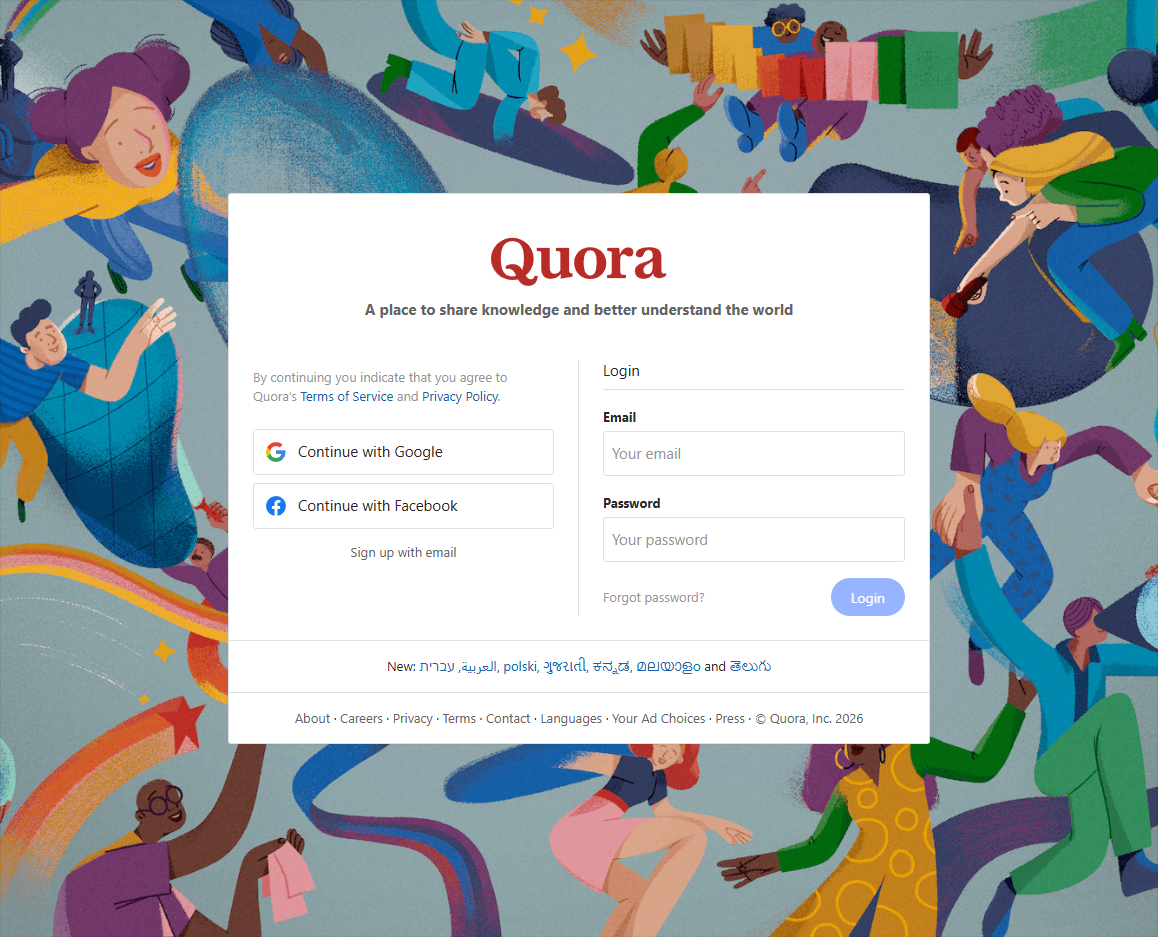
Question-first design
Quoraโ€s core unit is the question rather than the post. That design encourages answers to gather around a durable prompt, so future readers can find explanations, personal experience, expert context, debate, and links in one place instead of chasing scattered comments across the web.
Founders and Facebook roots
Quora was founded in 2009 by Adam Dโ€Angelo and Charlie Cheever, both former Facebook employees. Dโ€Angelo had been Facebookโ€s chief technology officer, and the founders brought social-network ideas such as identity, feeds, following, and ranking into a knowledge-sharing product.
Answers, credentials, and ranking
A useful Quora answer is expected to address the question, explain reasoning, and be understandable without forcing readers to leave the page. Credentials, upvotes, downvotes, comments, moderation, topic expertise, and ranking systems help decide which answers become most visible.
Spaces, feeds, and distribution
Quora expanded beyond individual questions with feeds, topic pages, notifications, and Spaces, which let people curate or publish around interests. These features make Quora feel more like a social platform, where distribution can depend on follows, recommendations, engagement, and moderation.
Monetization and incentives
Quora has used advertising, subscriptions, promoted answers, and creator programs at different points. Those incentives can help fund the platform and reward contributors, but they also create recurring tension around answer quality, SEO-style writing, paywalls, self-promotion, and content farming.
Poe and the AI turn
Quoraโ€s company now frames its mission around growing collective intelligence through both human knowledge sharing and AI collaboration. Poe extends that mission by aggregating access to AI models and letting creators build bots, giving Quora a second identity beyond question-and-answer pages.
Rise and pressure
Quora rose by making expert and personal knowledge easier to discover through search and feeds. Its pressure comes from moderation challenges, declining trust in low-quality answers, competition from Reddit, Wikipedia, search snippets, AI chatbots, and the difficulty of balancing open participation with credibility.
Why it matters
Quora matters because it shows both the promise and the messiness of crowdsourced knowledge. At its best, it connects curious readers with people who know something useful; at its weakest, it reveals how incentives, ranking systems, and platform growth can blur expertise, opinion, and promotion.
WHOIS domain data
Data pulled: May 24, 2026View current WHOIS record
- Domain
- quora.com
- IP address
- 100.25.208.228
- Registrar
- CSC Corporate Domains, Inc.
- WHOIS server
- whois.corporatedomains.com
- Referral URL
- http://cscdbs.com
- Created
- March 29, 2000
- Updated
- March 25, 2026
- Expires
- March 29, 2027
- Nameservers
- ns-344.awsdns-43.com (205.251.193.88); ns-1573.awsdns-04.co.uk (205.251.198.37); ns-1143.awsdns-14.org (205.251.196.119); ns-673.awsdns-20.net (205.251.194.161)
- Domain status
- clientTransferProhibited; serverDeleteProhibited; serverTransferProhibited; serverUpdateProhibited