CodeSandbox
CodeSandbox is an online development platform for creating, running, previewing, sharing, and collaborating on web projects in browser-based and cloud-hosted development environments.
What CodeSandbox is
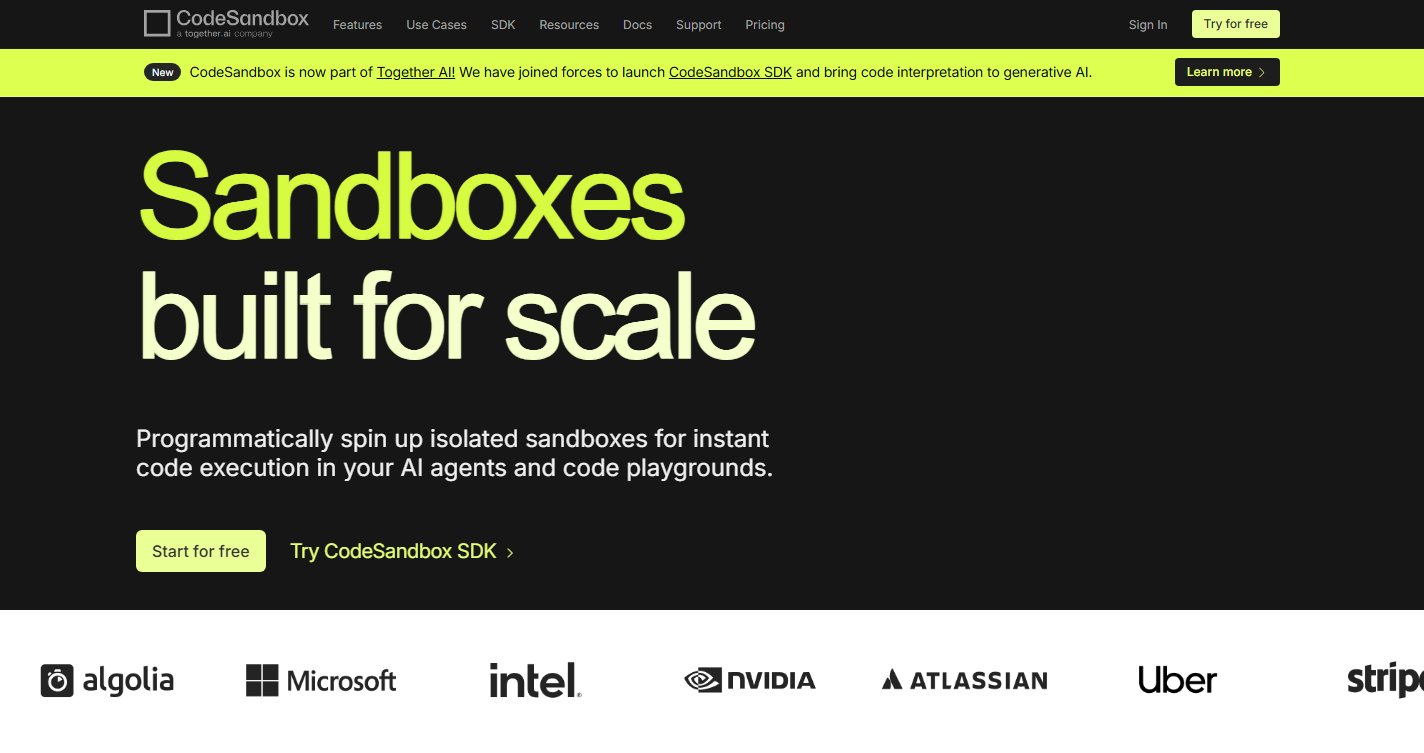
CodeSandbox is a web-based development platform for building and sharing runnable code projects. Visit CodeSandbox.io to see how the service presents itself as a platform for isolated sandboxes, instant code execution, AI agents, and code playgrounds. For many developers, it is also familiar as a place to open a frontend example, edit files in the browser, install packages, and share a live preview link.
Browser sandboxes and VM sandboxes
CodeSandbox now describes two main development environments. Browser sandboxes are lightweight and useful for front-end JavaScript experiments, quick examples, embeds, and documentation demos. VM sandboxes, previously called Devboxes, run in cloud virtual machines and are meant for larger prototypes, backend services, Docker-based environments, terminals, tasks, and VS Code integration.
Live previews change the workflow
A major attraction is that code and preview sit close together. A user can edit files, see a running app, inspect console output, and share the result through a URL. That makes CodeSandbox useful for teaching, bug reports, design handoff, open-source examples, and conversations where people need to look at the same running project rather than exchange setup instructions.
Templates, dependencies, and embeds
CodeSandbox lowers the friction of starting from a known stack. Templates can create a project with a framework and package setup already in place, while dependency tools help add or update npm packages. Browser sandboxes can also be embedded in articles, docs, and learning material so readers can inspect or run code without leaving the page.
GitHub and cloud development
The platform has offered GitHub-connected repository workflows, branch-based cloud environments, pull request review flows, and collaboration features. Its current documentation also says CodeSandbox Repositories stopped accepting new imports on April 1, 2026, and that full support is scheduled to end on July 1, 2026, with migration guidance toward GitHub Codespaces. That makes the page important to understand both as a code playground and as a cloud development product whose emphasis has shifted over time.
Strengths and limits
CodeSandbox is strongest when a project needs to be opened quickly, shared clearly, or run in a controlled environment. It can be less ideal when a team depends on private infrastructure, unusual hardware, long-running local services, or workflows that are tightly bound to a developer's own machine. Like other cloud coding tools, it also raises practical questions about cost, secrets, repository permissions, network access, and how much of a project should live in a hosted environment.
Why it matters
CodeSandbox helped make runnable code examples feel like part of the web itself. Instead of treating examples as static snippets, it showed how a browser tab could become an editor, package manager, preview server, and collaboration space. That idea now connects directly to a wider shift toward cloud development environments and AI systems that need safe places to execute code.
WHOIS domain data
Data pulled: May 24, 2026View current WHOIS record
- Domain
- codesandbox.io
- IP address
- 172.64.144.247
- Registrar
- NameCheap, Inc.
- WHOIS server
- whois.namecheap.com
- Referral URL
- https://www.namecheap.com/
- Created
- November 23, 2016
- Updated
- October 26, 2020
- Expires
- November 23, 2029
- Nameservers
- adel.ns.cloudflare.com (173.245.58.55); greg.ns.cloudflare.com (172.64.33.115)
- Domain status
- clientTransferProhibited
- Registrant contact
- Redacted for Privacy; organization Privacy service provided by Withheld for Privacy ehf; Reykjavik, Capital Region, IS; phone +354.4212434
- Admin contact
- Redacted for Privacy; organization Privacy service provided by Withheld for Privacy ehf; Reykjavik, Capital Region, IS; phone +354.4212434
- Tech contact
- Redacted for Privacy; organization Privacy service provided by Withheld for Privacy ehf; Reykjavik, Capital Region, IS; phone +354.4212434
- Contact email
- f72b8bb315b1454f8de72cd0cd9c8ce2 [dot] protect [at] withheldforprivacy [dot] com
- DNSSEC
- unsigned