Wikidata
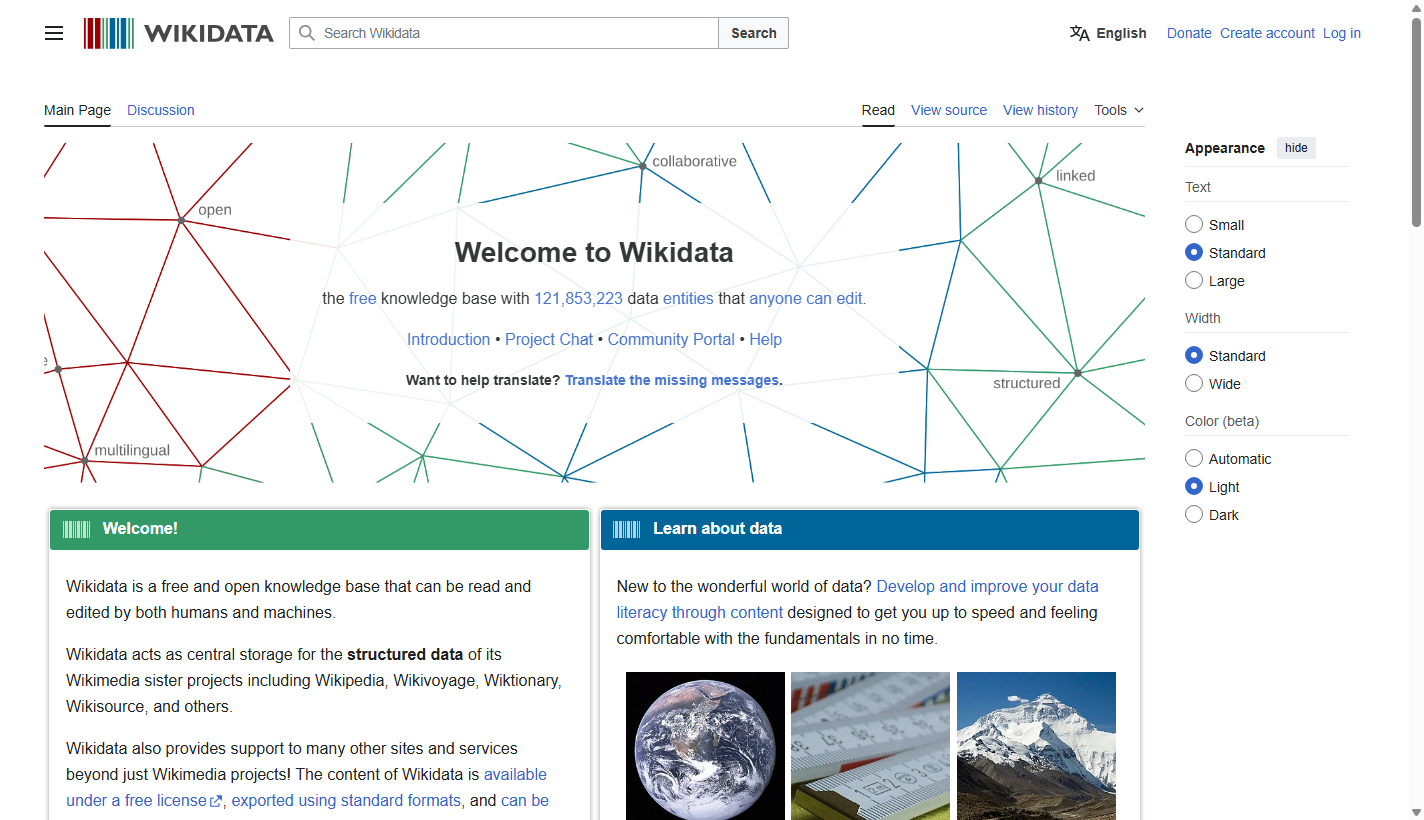
Wikidata is a free, collaborative, multilingual structured knowledge base that stores machine-readable facts used by Wikimedia projects, search systems, apps, researchers, and data tools.
What Wikidata is
Wikidata is a free structured knowledge base in the Wikimedia family. On Wikidata.org, people and software can read, edit, query, and reuse facts about people, places, works, organizations, concepts, events, identifiers, and relationships in a machine-readable form.
Items, properties, and statements
A Wikidata page is usually an item, such as a person, city, book, species, film, or scientific concept. Each item can have labels in many languages, descriptions, aliases, identifiers, and statements. A statement links an item to a property and value, such as a birth date, coordinate location, official website, creator, population, or external database ID.
A knowledge graph for many languages
Wikidata helps avoid repeating the same facts separately across language editions. A single item can connect names, identifiers, and relationships in many languages, making it easier for Wikipedia and other projects to share structured facts while still writing local article prose independently.
Human and machine editing
Wikidata is edited by volunteers, tools, bots, and data imports. That mixture makes it powerful and delicate. Large datasets can improve coverage quickly, but every claim still needs modeling choices, references, constraints, community review, and cleanup when sources disagree or facts change.
Queries and reuse
Developers and researchers use Wikidata through APIs, dumps, entity pages, and SPARQL queries. That makes it useful for data visualization, search enrichment, authority control, catalog matching, digital humanities, linked open data, language tools, and experiments that need structured facts rather than text paragraphs.
Strengths and limits
Wikidataโ€s strength is that it makes public knowledge computable. Its limits come from uneven coverage, modeling disputes, vandalism, stale values, source quality, identity matching problems, and the difficulty of representing messy reality as clean statements.
Why it matters
Wikidata is one of the webโ€s most important public knowledge graphs because it connects human-readable projects with machine-readable data. It helps computers answer questions, connect collections, translate labels, identify entities, and reuse open facts without depending entirely on private databases.