Glitch
Glitch was a creative web development platform where people could build, remix, host, and share web apps in the browser; its official site now functions mainly as a blog and transition archive after project hosting ended in 2025.
What Glitch is
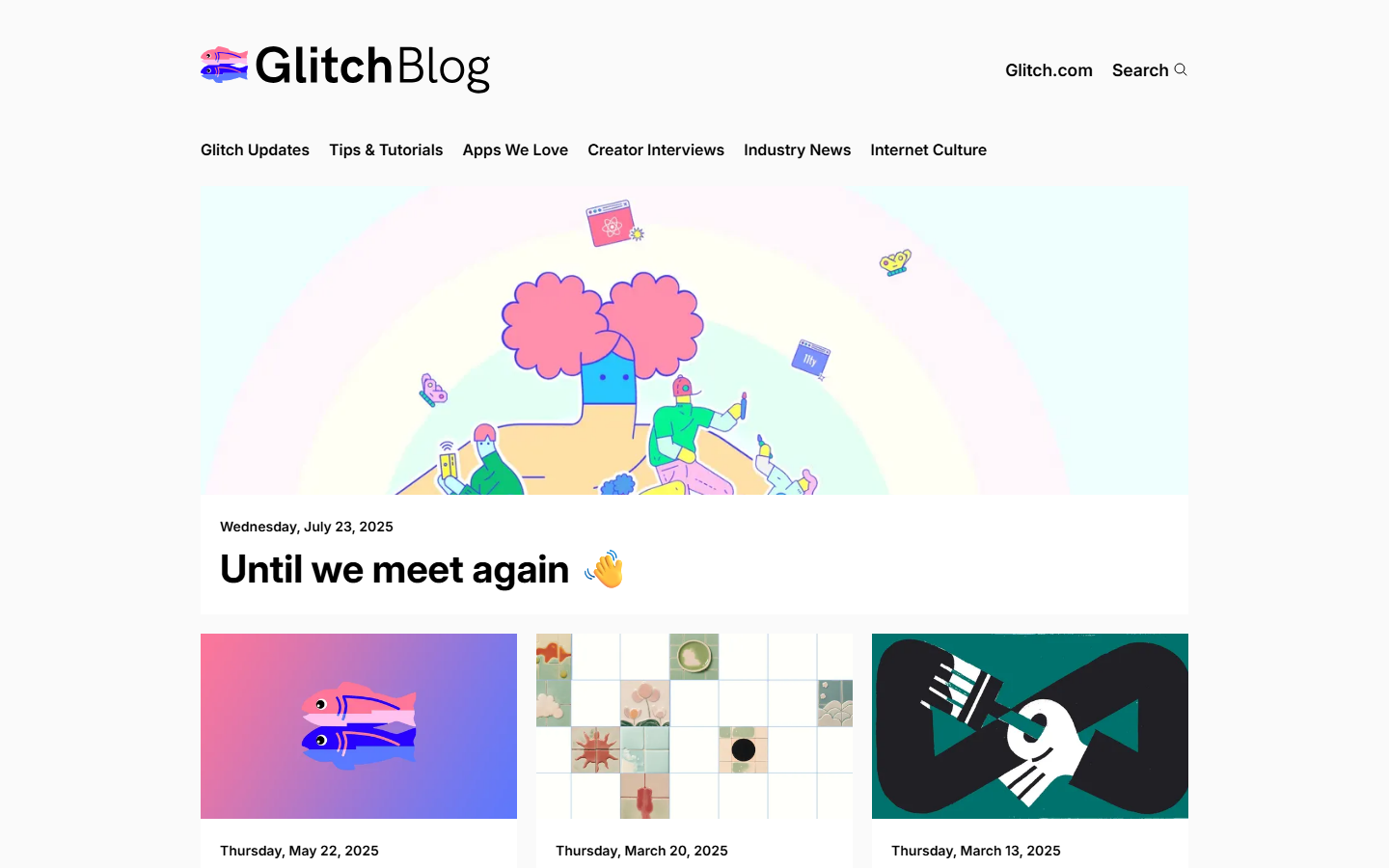
Glitch was a web platform for making, remixing, hosting, and sharing small web apps directly from the browser. Visit Glitch.com today and the official site redirects to the Glitch Blog, which preserves updates, community stories, migration notices, and farewell posts after the project-hosting service wound down.
How the platform worked
The original Glitch experience was built around immediacy. A user could open a project, edit code in the browser, see the result run online, and share a public URL. Remixing was central: instead of starting from a blank folder, people could copy an existing project, learn from its files, and reshape it into something new.
Why people liked it
Glitch made web development feel more approachable than a traditional toolchain. It was useful for classrooms, demos, bots, small APIs, art projects, interactive explainers, experiments, and early prototypes. The platform's public project culture made it feel closer to a creative web community than a purely professional deployment product.
Rise, acquisition, and shutdown
Glitch launched publicly in 2017 and presented itself as a place where people of many skill levels could create the web. In May 2022, Fastly announced that it had acquired Glitch. Three years later, in May 2025, Glitch announced that project hosting and user profiles would shut down on July 8, 2025, citing the cost of running millions of apps, abuse pressure, aging architecture, and a changed ecosystem with many newer hosting options.
The blog and archive role
After hosting wound down, the official web presence became more of a record than a creation tool. The Glitch Blog still points readers to updates, community stories, support resources, and the remaining dashboard/download window. That makes the modern Glitch page unusual: it represents both a brand and the memory of a platform that many developers used to learn and publish quickly.
Strengths and limits
Glitch's strength was reducing the time between idea and working URL. Its weakness was that hosted code at large scale still needs infrastructure, moderation, security, uptime, funding, and migration paths. The shutdown showed that friendly creative tools still face the same hard economics and abuse problems as other hosting platforms.
Why it matters
Glitch helped popularize the idea that coding on the web could be social, remixable, and instantly publishable. Even after its hosting service ended, its influence remains visible in browser IDEs, online sandboxes, educational coding tools, and platforms that treat examples as runnable projects rather than static snippets.
WHOIS domain data
Data pulled: May 24, 2026View current WHOIS record
- Domain
- glitch.com
- IP address
- 151.101.66.132
- Registrar
- MarkMonitor Inc.
- WHOIS server
- whois.markmonitor.com
- Referral URL
- http://www.markmonitor.com
- Created
- November 20, 1997
- Updated
- April 14, 2026
- Expires
- November 19, 2027
- Nameservers
- ns-cloud-d1.googledomains.com (216.239.32.109); ns-cloud-d2.googledomains.com (216.239.34.109); edns1.ultradns.com (204.74.66.1); edns1.ultradns.net (204.74.110.1); elm.fastlydns.org (167.82.229.3); elm.fastlydns.com (157.52.78.3); elm.fastlydns.dev (157.52.79.3); elm.fastlydns.net (167.82.228.3)
- Domain status
- clientDeleteProhibited; clientTransferProhibited; clientUpdateProhibited
- Registrant contact
- Domain Administrator; organization DNStination Inc.; San Francisco, CA, US; phone +1.4155319335; fax +1.4155319336; email admin [at] dnstinations [dot] com
- Tech contact
- Domain Administrator; phone +1.4155319335; email admin [at] dnstinations [dot] com
- DNSSEC
- unsigned